
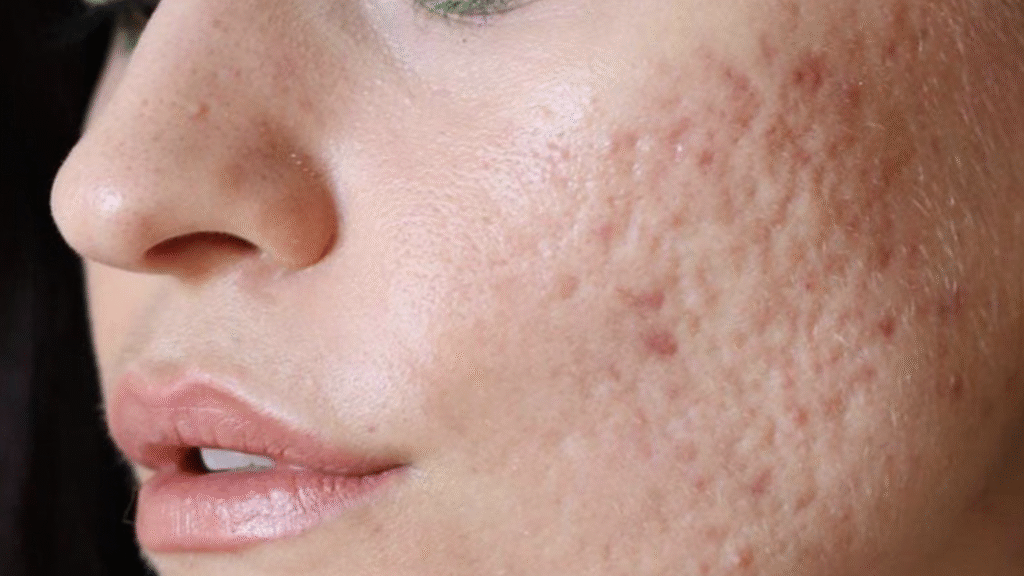
About one-third of acne sufferers develop permanent scarring (>70% in cases of severe acne)
Acne scarring is divided into two major categories — atrophic (depressed) and hypertrophic (raised).
Atrophic scarring is commonest consisting of
- Ice-pick scars – deep, narrow tracts that taper to a point
- Boxcar scars – wider depressions with sharp, well-defined edges
- Rolling scars – broad, shallow depressions with sloping edges caused by fibrous bands tethering the skin down
Hypertrophic scarring
- Hypertrophic scars – raised, thickened scars that stay within the boundary of the original lesion
- Keloid scars – overgrown scar tissue that extends beyond the original acne area
Invariably, patients will show many different types of acne scarring often admixed with post inflammatory dyspigmentation (erythema, hyperpigmentation, hypopigmentation)
As a result most patients need combination therapy over staged sessions, not a single treatment.
Acne scarring cannot be completely reversed, the aim of treatment being to provide adequate improvement. As a guide:
- Mild scars — may achieve 70–90% improvement
- Moderate scars — typically 50–70% improvement
- Severe/deep ice-pick or long-standing scars — usually 30–50%, even with optimal therapy
Available treatments include:
- Collagen-remodelling procedures for atrophic scarring:
- Microneedling / RF Microneedling
- CO₂ / Er:YAG Laser
- TCA CROSS
- Subcison
2. Filler/biostimulation to “lift” or thicken depressed scars
- Hyaluronic acid fillers
- Biostimulators (calcium hydroxy apatite)
- Autologous fat transfer
3. Scar excision (deep or confluent scarring):
- Punch excision
- Ellipitcal excision
4. Hypertrophic and Keloid Scar Control
- Iintralesional triamcinolone)
- 5-FU / steroid combinations
- Silicone gel or sheets
4. Dyspigmentation (post inflammatory erythema, hyper- and/or hypo-pigmentation)
- Light and medium strength chemical peels
- Intense Pulse Light
- Vascular lasers
- Pico-lasers